Inside the CISO & AI Assembly: Key Insights & Takeaways

CISO AI Governance: Lessons from Millennium’s CISO Assembly

The AI Governance Problem Is Mostly a Basics Problem

At our Transformational CISO Assembly in Atlanta on October 7, a keynote speaker asked the room a simple question. Who here is fully confident they know every AI and SaaS tool running in their environment?

One hand went up.

That moment set up the next two days. Under every session was the same pressure. AI is moving faster than anyone’s plan for it, and security leaders are being asked to steer through change they can’t fully size up yet. CISOs don’t like being in that spot.

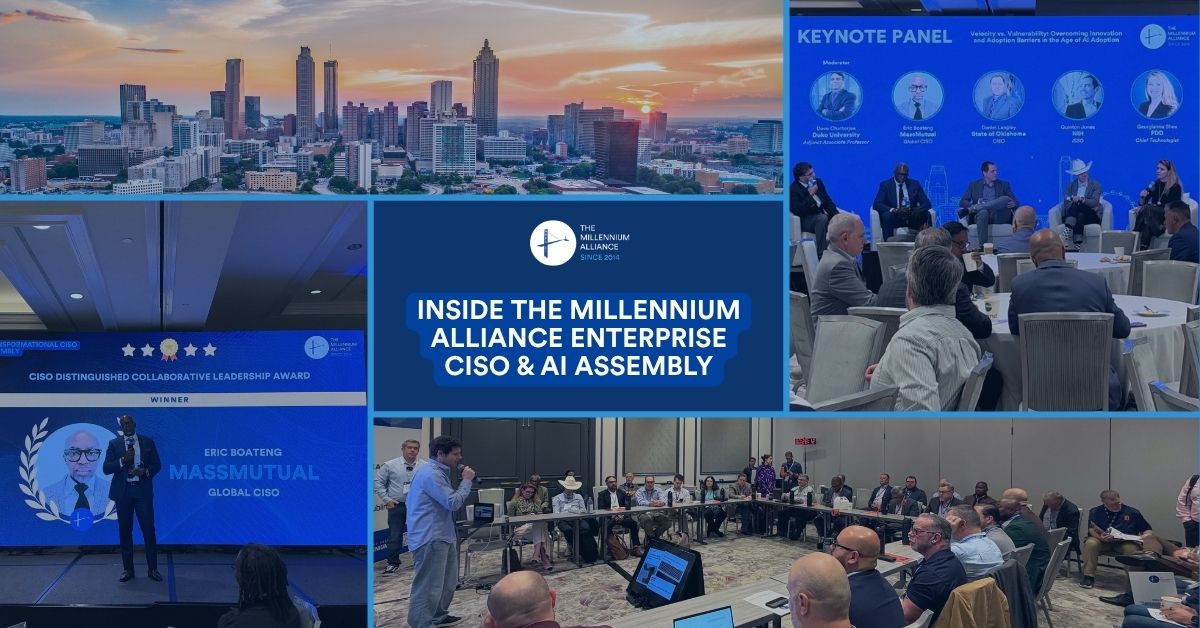
On Day 2, the keynote panel “Velocity vs. Vulnerability,” moderated by Dr. Dave Chatterjee, Adjunct Associate Professor at Duke University, brought together security leaders from financial services, state government, federal research and national security policy. A Day 1 fireside chat with ADT’s Deputy CISO added the operator’s view. The panel’s answer wasn’t to start over. It was to update the playbook, beginning with the basics AI is putting under stress.

The short list

  • Set your risk appetite first. The business moves faster when it knows where the guardrails are.
  • Fix the basics. AI speeds up whatever’s already weak in asset inventory, data governance and identity.
  • Go find the shadow AI. Unapproved MCP servers can be running before a governance committee ever hears about them.
  • Write down who owns what. That means who owns the risk, who’s accountable and who can take systems offline.
  • Widen your tabletops. Bring in legal, communications, executives and third-party scenarios.

What delegates told us before they arrived

Before each Assembly, we collect a short needs assessment from registered delegates, including the objectives their department is working on. We reviewed the responses for Atlanta. About 90 security decision makers took part, and here’s what they said.

AI topped the list, and most of those mentions were about governance, risk or security. Only about three in ten framed it purely as adoption or automation. Here’s how the rest stacked up.

What Delegates Named as an Objective How Often
AI About 7 in 10
Compliance and Program Maturity About 3 in 10
Identity and Access About 3 in 10
Consolidation and Modernization, Led by Cloud and Infrastructure Migration About 1 in 5
Detection and Response, Data Security, Network and OT, Exposure Management, Application Security Each about 1 in 10 to 1 in 7

This is what delegates said going in, not what was discussed in the room. Still, the pairing is worth noticing. They arrived focused on AI governance, with identity and compliance close behind. On stage, the answers kept coming back to inventory, ownership and identity.

1. Security done well makes the business faster

Eric Boateng, Chief Information Security Officer and Head of Enterprise Cyber Security at MassMutual, opened the panel by flipping the usual question.

“The question is how much security risk are we prepared to take while we try to innovate with AI.”

Set that appetite, he said, build the guardrails, and teams can move inside them. “We speed in our cars because we have brakes. That is risk management.” Quinton Jones, Information System Security Officer at the National Institutes of Health, took the analogy further. Without brakes, “our maximum speed we would ever safely be able to go is maybe five, possibly 10 miles an hour.”

Exceptions work the same way. When the business needs to go outside the guardrails, Eric said, it “has to be well documented. It has to be time bound with compensating controls.” Senior management decides who owns it, somebody monitors it and a mitigation plan follows. The answer to a product team is never a flat no. It’s yes, within these limits, and here’s the paper trail.

He also tightens his own scoreboard. “If I am green on metrics, I go back and tighten the thresholds because green metrics is bad, by the way.” The thresholds come from a year of his team’s vulnerability and patching data.

Later in the day, Eric accepted The Millennium Alliance CISO Distinguished Collaborative Leadership Award at lunch. His parting words to the room were the same idea: “if security is done right it’s going to enable speed.”

2. AI is an accelerant, and the fuel is your existing mess

Daniel Langley, CISO at the State of Oklahoma, didn’t hedge.

“We don’t truly have to rewrite the book with controls and how policies and governance and how we do things. It’s just adding another layer to it. It’s not a change completely. It’s an add-on.”

What that layer needs underneath it, he said, is to “truly get down to the basics on some aspects, like truly understanding your asset management, understanding what your environment is like, what is out there.”

Rick DeLoach, Deputy CISO and Senior Director at ADT, landed in the same place: “AI is an accelerant.” Dr. Georgianna Shea, Chief Technologist of the Transformative Cyber Innovation Lab at the Foundation for Defense of Democracies (FDD), said organizations are still getting hurt by “the low hanging fruit that we’re getting tripped up on.” Add AI as a force multiplier and those hygiene problems get worse.

Eric tied it to data: “If you have poor data governance, you’re going to have bad AI governance because it feeds with each other.” He expects agentic AI to be the big one. “In the next couple of years, agentic risk will be the number one risk that we have, because you have tons of these agents talking to each other.” His starting point is inventory. How many agents do you have, who owns them and what are they doing? An agent can have a valid identity and still misbehave. “They could be the right identity, but might be behaving the way it was not intended to do.”

Georgianna added two cautions.

  • Risk registers. Likelihood scores often lean on whether something has happened before, and speed changes that. “All of these fundamental assumptions that we’ve been taking for granted and working off of really need to be reexamined.”
  • Compliance. “You can be compliant but not be secure.” In her reading, the NIST controls used in assessments don’t test AI. They look at the confidentiality, integrity and availability of data, not whether you can trust it. On cryptography, the control “just says, do you have a crypto program?” Check the box and move on.

For a CISO, the AI program and the basics program are the same program. An agent inventory is an asset inventory. Agent permissions are an identity problem.

3. You can’t govern what you haven’t found

Rick shared a story from ADT’s weekly AI governance committee. His team raised MCP servers. The committee’s answer: “we don’t have any MCP servers because we haven’t approved any.” So his team pulled data from their own tools and showed them. A fair number were already in the environment.

His point was about the operating model, not the people. Threat actors don’t wait for change control boards, and “governance councils, those are, you know, old operating models and we need to move at speed.” If your review process depends on requests arriving through the front door, it misses everything that came in another way.

Oklahoma goes after the same problem from the network side. Daniel described it this way: “Anytime AI is used in the state of Oklahoma, we actually get an alert. We get the prompt and response, and if they try to upload a document, we actually capture that document at the same time.” It isn’t a gotcha, he made clear. The goal is to see what’s happening so the state can respond at the speed things now move.

Back to the one hand in the Day 1 room. The first job of an AI governance program is finding things. Policy comes after.

4. Decide who owns it before the incident starts

The panel was built around three ideas from Dr. Chatterjee’s framework: commitment, preparedness and discipline. Under commitment, the first question was who owns the risk. The answers were sharper than “the CISO.”

Daniel split apart two things leaders tend to blur: “there’s a difference between owning and who’s actually accountable.” Everyone who touches a system owns some of its risk, he said, but accountability sits with someone specific. At the State of Oklahoma, that’s typically him or the CIO. Eric described the financial services version. System owners decide within the risk appetite, and anything past tolerance escalates through risk committees, up to the board.

An attendee asked what happens when a data risk owner leaves and nobody wants the job. Eric reframed it: “We don’t have a data risk issue. We have a resiliency issue.” His fix is a named co-owner for every critical inventory item. “There’s always going to be a co-owner, someone who is equally knowledgeable and have the seniority to make some decisions.”

Authority gets the same treatment. Rick said ADT’s incident response plan spells out, with executive sign-off, “that we have the authority to take systems offline if there’s deemed to be a threat in the environment.” The reason is simple.

“So we don’t get into an incident bridge, and we’re trying to figure out who has the authority to do what. Like if you’re trying to do that, it’s already too late.”

Georgianna was blunt about resilience: “if you’re planning on just protecting the system, you’re going to fail.” She starts from the mission, maps the critical functions behind it and the technology that supports them, and works out the minimum service the organization has to keep running through an attack.

5. Rehearse with everyone in the room

Daniel’s test for a backup plan: “if you say you have a full live backup system, but you’ve never tested it, you have theoretically a backup system.”

Eric described how far MassMutual takes rehearsal. His teams run third-party compromise tabletops and zero-day tabletops, plus a combined scenario where a third-party compromise arrives through a zero-day. There are executive-level sessions with the CEO in the room. The biggest problem in a tabletop, he said, is communication: “who to talk to, at what point, who do we inform.”

An attendee whose company serves the banking sector told the room what happens when you widen the exercise. Their insurer facilitated a tabletop that brought in the CEO and the legal team, and added a scenario the team hadn’t planned for, in which “all of our credentials got exposed to the internet.” One panelist’s reply: “If you have not involved every aspect of it in those planning sessions, you haven’t done it.”

Four checks to run this month

  •  Risk appetite. Is it written down, with a documented, time-bound path for exceptions? If product teams can’t see the guardrails, they’ll build around them.
  •  AI inventory. Does it come from your own tool data or from intake forms? The MCP story suggests the two can differ.
  •  Ownership. Does every critical risk have a named owner and a named co-owner? Does your incident plan say, with sign-off, who can take systems offline?
  •  Next tabletop. Is it built around a third-party compromise, with legal, communications and executives at the table?

The questions above didn’t stay on the stage. Who owns the risk and who’s accountable came up again in the workshops and roundtables, and the room didn’t always agree. Delegates drew the line in different places, and the answers shifted with the size of the organization and the industry. Nobody needed to settle it. Hearing how a peer in another sector or at a different scale handled the same question kept the conversation going, and gave people something to compare against their own setup.

That’s a big part of why delegates came. They wanted to hear how peers were handling it, and to know they weren’t facing it alone. They also wanted to see the new solutions showing up almost daily, so they could tackle a problem or just stay on top of what’s new.

That conversation picks up again at our Transformational CISO Assembly, December 1 and 2 at The InterContinental in New Orleans. The agenda includes sessions on streamlining enterprise AI intake and review, how peers define data-access tiers and real-time circuit breakers for autonomous agents, and modernizing incident response for cloud and AI breaches. Details are at mill-all.com.


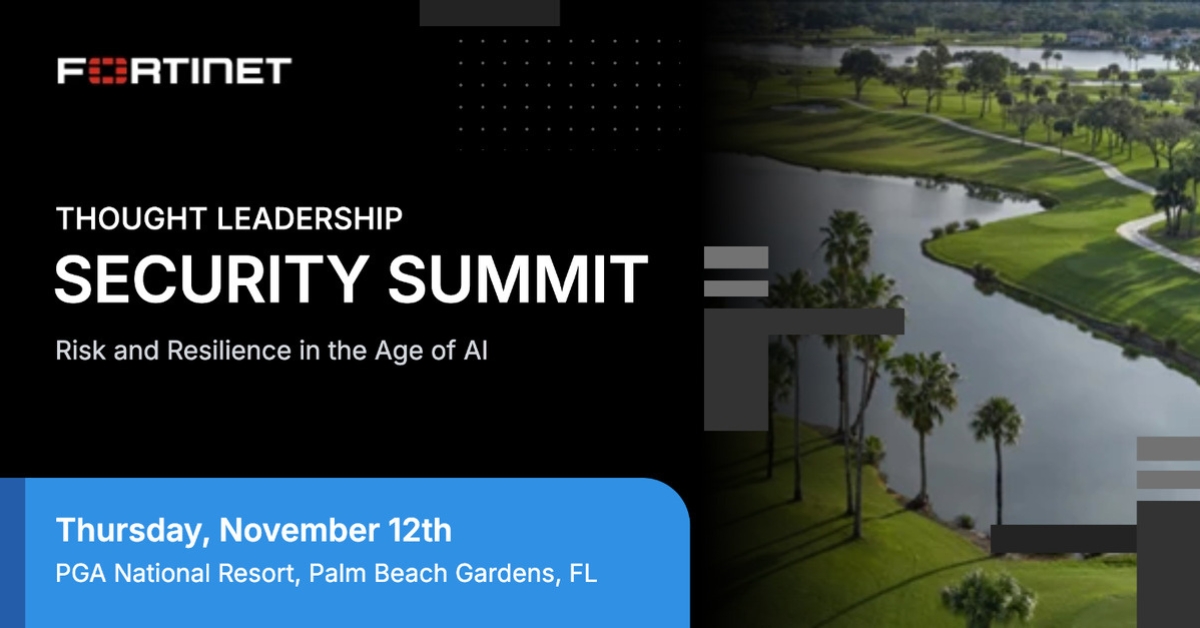
Risk and Resilience in the Age of AI | Fortinet Thought Leadership Security Summit

In partnership with Fortinet

Date: Thursday, November 12, 2026, 8:30 a.m. to 1:30 p.m. ET
Location: PGA National Resort, Palm Beach Gardens, FL
AI is arming attackers and defenders at the same time. Join CISOs, CIOs and security leaders for a focused morning of plenary sessions and peer panels on how adversaries use AI, how to harden your defenses against AI-driven attacks and how to govern AI adoption without slowing the business. Speakers include Derek Manky, Fortinet‘s Chief Security Strategist, along with IT and security leaders from Hertz, DHL Express, Equinix and TBC Corporation. Stay for lunch and an optional round of golf hosted by Fortinet.
Seating is limited. Reserve your seat: https://events.fortinet.com/thoughtleadershipsecuritysummit2026_fl

About Fortinet

Fortinet makes possible a digital world that we can always trust through its mission to protect people, devices, and data everywhere. This is why the world’s largest enterprises, service providers, and government organizations choose Fortinet to securely accelerate their digital journey.

To learn more, visit www.fortinet.com

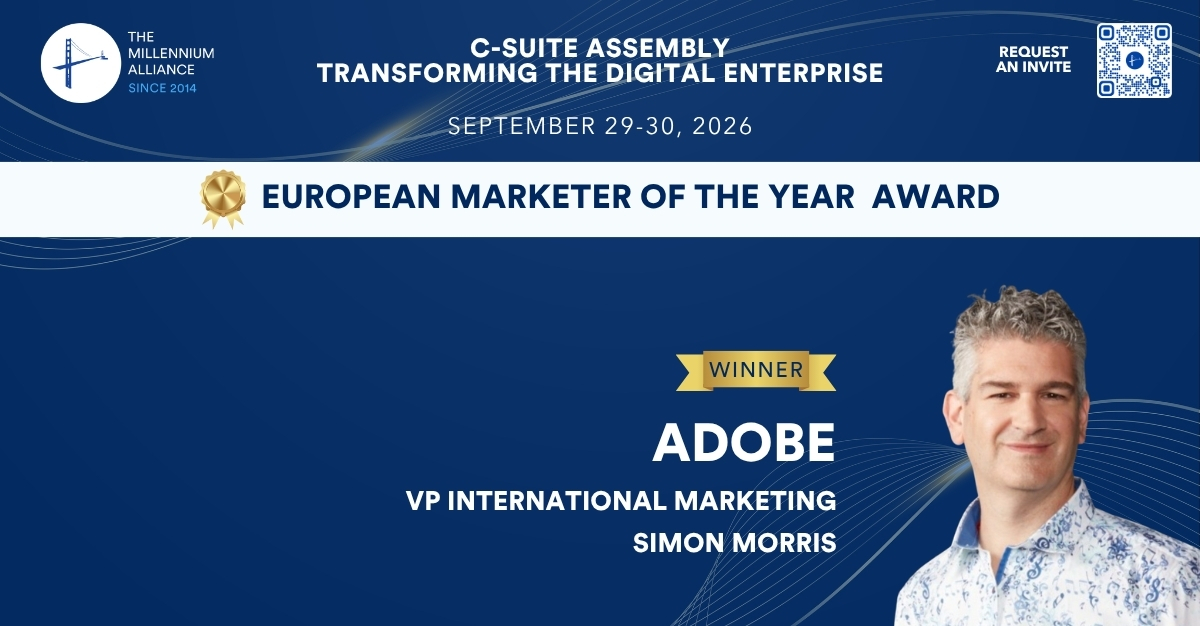
Simon Morris, VP International Marketing at Adobe, Recognized as European Marketer of the Year!

The Millennium Alliance is proud to announce that Simon Morris, VP International Marketing at Adobe, received the European Marketer of the Year Award at our European Transformational B2B CMO Assembly, held September 29–30 at the Leonardo Royal Hotel in Amsterdam.

See the full list of winners and learn how you could be our next nominee—visit our Awards Page!

About Simon Morris

A charismatic Marketing Executive used to working in the Enterprise Software market. Specific, deep industry knowledge of Digital Marketing, Mobile Workforce Management, and closely working with partners such as Accenture, IBM, Microsoft and SAP.

A track record of driving significant market demand and establishing ‘market leadership’ in the minds of prospects, partners and analysts. From brand awareness and public relations, to event management and online and offline marketing, extremely successful qualitative and quantitative marketing results have been produced. Experience across B2B and B2C sectors.

#MillenniumLive: Beyond the Score: Confidence, Cost, and The Future of Cognitive Care with Elli Kaplan, Founder and CEO of Neurotrack

Elli Kaplan, Founder & CEO at Neurotrack, joins the podcast to talk about what’s changed over the last two years, the growing cost of inaction, and why a cognitive screener alone may not be enough. Elli shares how Neurotrack is going beyond a score to create a broader cognitive care enablement platform—one designed to bring together the clinical context clinicians need, fit into existing workflows, and support confident decision-making. Elli also look at what it really takes for health systems to implement this kind of solution without adding another disconnected tool to an already complex technology environment. And like we do on so many of our episodes, we’ll look ahead: What could cognitive care look like five years from now if health systems get this right—and what does that mean for patients?

The Millennium Alliance | #millenniumlive | #cognitivehealth

Listen on Spotify, Apple, Amazon Music

About Neurotrack

Neurotrack is a cognitive care enablement platform that helps primary care teams detect, diagnose, and manage cognitive decline earlier. Founded on decades of neuroscience research, Neurotrack replaces outdated paper-based screeners with a fast, reliable digital assessment that fits into routine visits or can be self-administered by patients at home, before an appointment, or anywhere care happens. The result: providers gain the confidence to act on cognitive concerns rather than refer and wait, and patients get answers years sooner.

Earlier detection also carries direct economic value. Under CMS’s V28 risk adjustment model, accurate dementia diagnosis and documentation protect appropriate reimbursement, while earlier intervention reduces the avoidable hospitalizations and emergency utilization that drive costs in undiagnosed populations. With seamless integration into leading EMRs, including Epic, Neurotrack partners with health systems, health plans, and value-based care organizations to close the gap between the first signs of cognitive decline and a documented diagnosis with a care plan behind it.

To learn more, visit www.neurotrack.com

Applied AI Redesigning Work Operations with Phenom

In partnership with Phenom

4-5 November 2026 | PARIS, France | H4 Wyndham Paris

1.5 Days | 25+ sessions & breakouts | 30+ speakers | 500+ attendees

Every organisation is under pressure to adopt AI for their workforce operations, but most lack the tools and strategy to support it.

IAMPHENOM Europe brings together global leaders for a packed day of learning from the experts and your peers, outlining the playbook for applying AI, agents, automation, and experience to redesign work operations.

Join Phenom in Paris and be part of the conversation shaping the future of work.

Register today to secure your spot.

About Phenom

With a purpose of helping a billion people find the right work, Phenom is an applied AI company that helps organizations hire faster, develop better and retain longer.

To learn more, visit www.phenom.com.

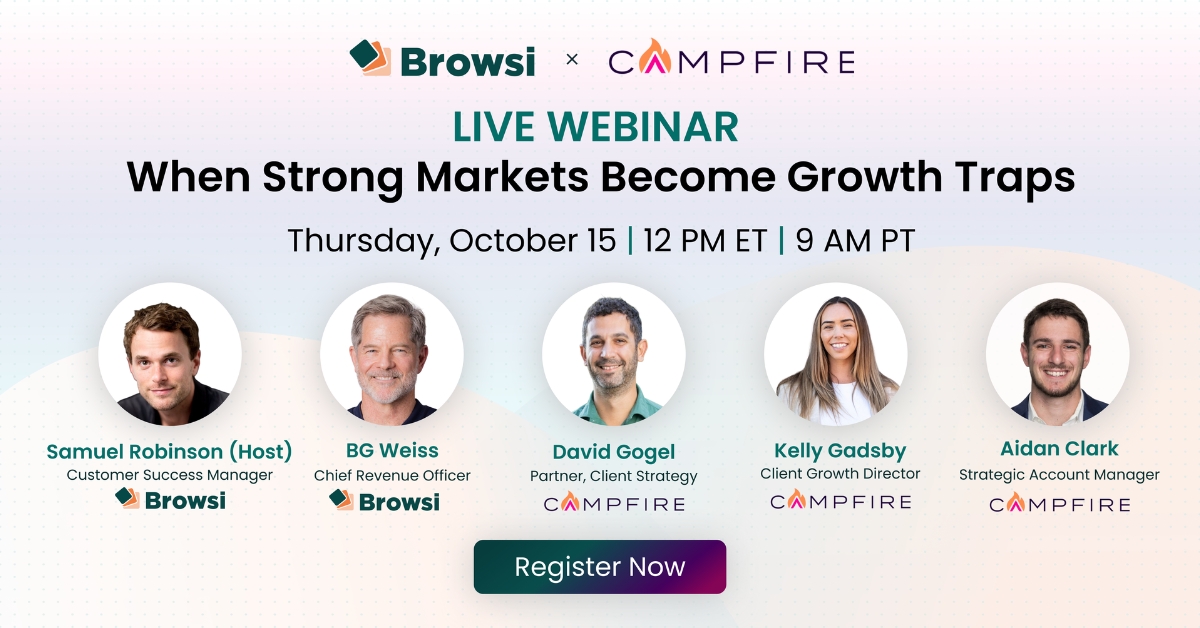
Live Webinar: When Strong Markets Become Growth Traps with Browsi

In partnership with Browsi

Most brands put next year’s budget where they won last year. It feels safe. However, in a shrinking category, your strongest markets are often where competitors pile in, and every point of growth there costs more than the last.

The team at Campfire saw it happen with a client, so they flipped the question. Instead of asking where the brand had always done well, they asked where competitors weren’t showing up. They used real-time competitive intelligence from Browsi’s PolarisAI to find markets with almost no competitive pressure, then moved the budget there.

On October 15, Campfire and Browsi walk through the whole story: the data, the pushback, and what happened once the campaign went live.

What you’ll learn:

  • Why historical sales data can point teams toward markets that are already saturated
  • How Campfire used competitor activity, CPM, and CTR to uncover whitespace 
  • How to challenge the assumptions behind a media brief
  • How a shared competitive view can align stakeholders and accelerate decision-making

Speakers: David Gogel, Kelly Gadsby and Aidan Clark from Campfire, with BG Weiss and Samuel Robinson (host) from Browsi.

Save your seat for October 15.

About Browsi

Browsi helps marketers and advertisers outperform their competitors’ ads with insightful data. Get a view of your campaign performance, your competitors’ strategy, and where you’re winning or falling behind.

To learn more, visit www.browsi.com.

The Business Case for Einvoicing with Fintua

Contributed by Fintua

Cost savings, cash flow and compliance benefits for global businesses

As eInvoicing mandates accelerate worldwide, global businesses can no longer treat eInvoicing as a local, back-office process. It’s now a strategic lever for cost reduction, cash flow and compliance.

This whitepaper outlines the commercial and compliance benefits of eInvoicing, showing how finance and tax leaders can move from fragmented, decentralised invoicing to a centralised, future-ready model.

What’s inside:

  • Why eInvoicing is becoming a global regulatory requirement
  • How decentralised eInvoicing models increase cost, complexity and compliance risk
  • The four pillars of an eInvoicing business case
  • Where organisations achieve measurable ROI, from processing costs to DSO and audit readiness
  • Which capabilities to prioritise when selecting an eInvoice provider

Download the Whitepaper here.

About Fintua

Fintua is a global indirect tax technology company helping multinational businesses simplify and automate VAT compliance, eInvoicing, VAT recovery and tax payments through one connected platform.

Built by tax experts for tax experts, the Fintua Platform brings together compliance, reporting, reconciliation and recovery workflows to give tax and finance teams greater visibility, control and confidence across jurisdictions. By combining intelligent automation, real-time insights and seamless ERP integration, Fintua helps organisations reduce compliance risk, improve efficiency and adapt to evolving regulatory requirements, including eInvoicing, digital reporting and VAT in the Digital Age (ViDA) initiatives.

Trusted by global enterprises, Fintua enables businesses to manage the end-to-end indirect tax lifecycle from a single platform, transforming tax from a complex administrative burden into a strategic business advantage.

To learn more, visit www.fintua.com.

Meta’s Enterprise AI Push Raises Bigger Questions for CIOs Featuring Alex Sobol

Contributed by Information Week

Featuring Alex Sobol, Co-Founder at The Millennium Alliance

CIOs expect new enterprise AI entrants to establish trust, not just provide better capabilities.

Meta is making a significant shift in where it sees its AI business growing: beyond the consumers who use its apps and into the enterprises that run their businesses on third-party software.

Meta Enterprise Platform, introduced Monday, brings its AI models, agents and developer tools together for businesses and developers. The company also hired former MongoDB CEO Chirantan “CJ” Desai, who has a background in enterprise software, to lead the effort. Meta has spent years building AI into Facebook, Instagram, WhatsApp and its other consumer products; now it wants companies to use that same technology to run parts of their businesses.

Meta isn’t the only AI company making that enterprise move. OpenAI unveiled Dots the following day, pitching the product as always-on AI systems that can pursue goals across applications and deepen the company’s push into enterprise work. Taken together, the moves point to a broader shift in the AI market: Companies that built the current generation of AI products are trying to turn those technologies into enterprise platforms, with agents providing a new route into business processes.

But enterprises aren’t starting from scratch. CIOs already have AI capabilities from the technology vendors they use today, so a new platform has to offer more than another set of features. It has to justify another layer of technology — and, critically, earn enough trust for its software to operate inside the business.

“Every new player in the space is just another thing to evaluate, secure and govern,” said Alex Sobol, co-founder and managing partner of The Millennium Alliance, a platform for C-suite peer-to-peer engagement.

Discover What’s Next for Enterprise AI. Read the Full Article Here.

About Information Week

For more than 40 years, InformationWeek has been a trusted source for CIOs and other IT leaders seeking comprehensive and authentic coverage of the constantly evolving world of technology and its impact on business. Our experienced and ethical journalists conduct in-depth examinations of crucial issues and the impact of global events on IT operations and strategies, helping forward-thinking executives stay at the forefront of their industries. InformationWeek also provides a platform for enterprise IT leaders and leading tech companies to share their insights and experiences through exclusive interviews, opinion pieces and events, offering firsthand accounts of strategies, trends and innovations.

For more information, visit www.informationweek.com

#MillenniumLive: The Cost of Standing Still: Is Your MHE Fleet Losing You Money? with UgoWork

Most people hear “electrification” and think of electric cars. But some of the biggest opportunities are happening in a much less visible place: the forklifts moving goods through warehouses and distribution centers. In this episode, we explore the hidden technology and cost gaps surrounding industrial material-handling equipment (MHE). JF Marchand, Marketing Director at UgoWork, examines why many fleets are still relying on outdated lead-acid technology, how the OEM and dealer ecosystem influences fleet-energy decisions, what differentiates UgoWork’s lithium solutions, and how its fleet intelligence platform turns battery data into actionable insights. The episode also covers the accelerating adoption of lithium, the tension between site-level uptime priorities and enterprise-wide asset efficiency, and how better data can help organizations close that gap. For supply chain and operations leaders, the takeaway is clear: the battery powering a forklift may be much more than an equipment decision. It can be a lever for productivity, visibility, and significant cost savings. About UgoWork: UgoWork is on a mission to eliminate energy waste in the material handling industry. We develop smart lithium-ion forklift batteries and charging infrastructure engineered for the real world: non-stop pressure, tough warehouse conditions, and constant changes on the floor. Beyond products, we address every energy challenge—from understanding power consumption and grid constraints to optimizing asset life and managing large-scale fleet transitions. Based in Québec, Canada, they power some of the largest S&P 500 and Fortune 500 operations across North America—making lift truck energy one less thing to worry about. Learn more at ugowork.com.

About JF Marchand

JF Marchand is the Marketing Director at UgoWork, a fast-growing technology company driving operational transformation in the industrial sector. A trained mechanical engineer with a career rooted in innovation, JF brings over 15+ years of experience helping international tech companies scale by aligning commercial strategy with purpose-driven product development. At UgoWork, he leads a multidisciplinary team across strategy, brand, demand generation, sales enablement, and outbound growth. With a sharp focus on delivering business impact, JF builds marketing and business development engines that prioritize operational efficiency, reduce waste, and accelerate enterprise adoption. JF is known for his strategic mindset, collaborative leadership style, and bias for action. He thrives in fast-paced environments where cross-functional alignment, creativity, and shared values fuel growth. For him, building successful teams is as much about having fun and developing people as it is about delivering results.

Listen on Spotify, Apple, Amazon Music

About UgoWork

UgoWork is an intelligent energy system designed, manufactured, and marketed for forklifts. More than a lithium-ion battery, it is a tool that relieves the pain associated with the operation of forklifts running on several shifts per day (typically more than 2,000 hours per year) in the food, pharmaceutical, retail, manufacturing, and logistics industries.

Due to lower operating costs and environmental concerns, the electric forklift market is currently gaining shares over internal combustion. However, fleet owners are limited by the performance of lead-acid batteries and, worse, waste time with a lot of dangerous handling. The undeniable advantages of lithium-ion mark a major break in the lead-acid era.

UgoWork believes that this is an era of services where critical activities are now worth outsourcing to real specialists. UgoWork has chosen to distinguish itself from traditional equipment suppliers by providing reliable and efficient energy rather than a simple battery. The business model (Energy as a Service) is therefore an important constituent of the differentiation of its offer.

To learn more, visit www.ugowork.com.

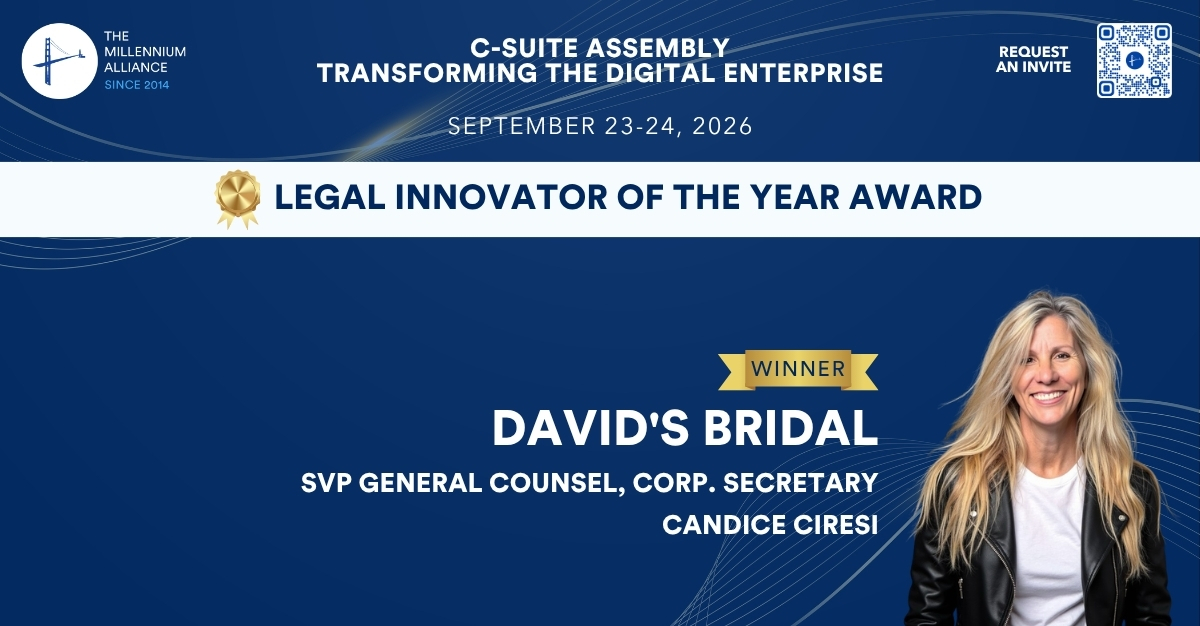
Candice Ciresi, SVP General Counsel, Corp. Secretary at David’s Bridal, Recognized with the Legal Innovator of the Year Award!

The Millennium Alliance is proud to announce that Candice Ciresi, SVP, General Counsel & Corporate Secretary at David’s Bridal, received the Legal Innovator of the Year Award at our Transformational Chief Legal Officer Assembly, held September 23–24 at The Wigwam Resort in Phoenix.

See the full list of winners and learn how you could be our next nominee—visit our Awards Page!

About Candice Ciresi

Candace is an accomplished legal executive with more than two decades of in-house experience across major public and private companies. Her expertise spans high-stakes governance, complex transactions, and enterprise risk, with a proven ability to protect the organization while enabling strategic growth.