America’s Best Hospitals Have These Positive Qualities In Common

In the healthcare industry, a good hospital is important. It represents the efforts that professionals make in this industry in order to effectively reach patients and give the best care possible.

Every year, Healthgrades create a list of hospitals that have proven to be the best in America. Out of all 50 states, hospitals are ranked and judged based on performance, following a unique set of guidelines.

“What are the measurements that demonstrate this exceptional quality? Simply put, patients treated at America’s Best Hospitals have a lower risk of dying and are less likely to experience in-hospital complications than if they were treated at non-recipient hospitals.” Healthgrades reports.

Transforming Organizations Stand Out

All in all, the organizations that have been most likely to transform their structures receive a higher rating than those who have not. Of course, patients who are put in the center of the hospital also stand a better chance at receiving a high rating on the list. A model in which “quality and safety” are top priorities for hospitals is a model that will strive to the top of the list.

So, what exactly does this list mean? According to HealthGrades, the hospitals listed as top 50 include hospitals that “are in the top 1% of hospitals in the nation for providing overall clinical excellence across a broad spectrum of conditions and procedures consistently for at least six consecutive years.”

The top 100 hospitals listed by Healthgrades are the hospitals who have scored a spot on the list for at least 3 consecutive years.

“America’s Best Hospitals is Healthgrades highest distinction. These hospitals exhibit exceptional, comprehensive, and consistent quality year over year. Simply put, patients are more likely to have a successful treatment without major complications—and have a lower chance of dying—at America’s Best Hospitals.” HealthGrades reports.

The top four characteristics that each hospital has to possess is patient-centered care, evidence-based decision making, collaboration, consumer and patient engagement.

But that is not all, c-suite representation also plays a role in the quality and strategies of the hospital because they determine the data that is provided throughout the hospital and play a core role in the structure of the hospital. With a weak c-suite, the hospital is met with issues, and most likely a low rating on the Healthgrades report.

Having the ability to make evidence-based decisions plays a huge role in hospital’s placement. Healthgrades uses an example of Delray Medical Center as a hospital who has implemented important initiatives like electronic order sets, and daily huddles that determine the clinical care. This also goes hand in hand with the hospital’s ability to collaborate with all payers in the structure.

“America’s Best Hospitals emphasize the importance of collaboration. Creating an environment of accountability with highly-engaged physicians, nurses, board members, and patients and their families will drive impactful cultural change both inside and outside the organization.” Healthgrades reports.

Collaboration creates active roles in patients journeys. It means that all members of the organization are on board with making sure that patients receive the best quality of care, which is the ultimate goal after all.

America’s 50 Best Hospitals

Among many more. You can find the full list here. 

ABOUT PATIENT EXPERIENCE TRANSFORMATION ASSEMBLY

Working with our Members and Advisory Board, we are putting a program to enable you PETto test out new technology and hear from experts about the latest strategies changing the patient experience. We understand that for C-Level executives time is precious, so we are bringing the best content and technology together this October in Denver to jump-start your transformation this fall.

Our agendas and attendee lists are for Millennium Members only. Apply today for access! Already a Millennium Member? Simply click the link and enter your password when requested.

Fractal Industries Offers an In-Depth Look into Leveraging Decision Platforms for Meaningful Analytics in Latest Whitepaper

The world is evolving to become more digital. With digital processes taking over, moving away from human intelligence to adapt to data-driven platforms is becoming more common.

This fundamental and necessary shift is resulting in exponential growth in data production, with increasingly different data types from vastly different sources. In Fractal’s new whitepaper Leveraging a Decision Platform for Meaningful Analytics, it all starts with an entirely new innovative approach that prioritizes up-front effort to process and implement data to benefit companies looking to leverage decision platforms for meaningful analytics.

Click to Download the Whitepaper by Fractal >>>

In their latest whitepaper, Fractal discusses 5 key points when looking to leverage decision platforms for meaningful analytics:

  1. Decomposing Data for Analytics
  2. Modeling Data to Extract Meaningful Insight
  3. Legitimate Integration of Disparate Security Data
  4. Extending Security Data Models to the Business
  5. True Competitive Advantage in a Digital World

Click here to see these 5 key points more in-depth.

By diving into these 5 points, Fractal ultimately offers a decision platform that
is truly an end-to-end solution to executives and professionals in the tech space searching for an answer to data-optimization for their businesses growth.

Contextualized information can now be presented in a way that enables Human+AI
collaboration to optimize decision-making and performance, at scale, to any domain.

Using this platform, users will become familiar with key available use cases that include and are not limited to:

  • Asset management, identification, & enumeration
  • User behavior analytics
  • Data loss prevention
  • Incident response enablement

Leveraging Fractal’s data management, simulation modeling, and machine learning technologies is an innovative approach to drive sales and optimize profitability in the growth of business strategy not only towards the end of this year, but when looking at 2019. These new pillars of business will emerge for the companies that are innovative and insightful enough to embrace the full spectrum of capabilities available in Fractal OS.

That being said, as a business executive looking to expand technological capabilities through understanding meaningful analytics through innovative approaches in the future, you should not miss out on the opportunity to take an exclusive look into the latest whitepaper by Fractal.

Click HERE to Access Now >>>
ABOUT THE TRANSFORMATIONAL CISO ASSEMBLY

In a new digital world, driven by data, businesses of all sizes are working tirelessly to Event Banner - CISO Miami (1) secure their networks, devices, and of course, their data. CISOs need to plan for worst-case scenarios, stay ahead of latest IT Security transformation technology, and maintain their company’s information assets without losing sight of the corporate culture.

This November, the 6th edition of our Transformational CISO Assembly will bring together industry leaders to discuss the latest strategies and innovations in cybersecurity in Miami. Join us today, the assembly is now open for application!

Download your copy of the sponsorship prospectus here for more information>>


Why 2018 Has Been the Year of the Voice in Healthcare

We are all too familiar with the greetings “Hey, Siri” or “Hey, Alexa” in our modern tech lives. If you haven’t, where have you been? Voice technology has been one of trends that has been constantly brought up and heavily discussed this year. In 2018 alone, voice technology has taken off and changed the way we hear and receive information – all within seconds of asking for it.

As voice technology becomes a bigger part of our daily lives, will we see it move beyond managing our playlists to managing our health? The answer is yes. 2018 has been the year of the voice in healthcare for many reasons, but is has been apparent as to voice technology is being adopted faster than any previous technology.  By presenting opportunities for healthcare organizations to connect with patients and caregivers like never before, voice technology is a driving force behind transformation throughout the evolving sector.

The Impact of Voice

Although most major voice tech products are not HIPAA compliant as of now, within these limitations, developers both in and out of the Amazon have already made remarkable strides toward making healthcare more efficient and accurate.

Following this example, several hospitals and health systems have embraced the Amazon app-like approach to the expansive world of voice assistants, creating their own ‘Skill’ in Amazon’s Alexa Skill store that users can download on their Echo devices to better connect with their audience:

Taken off of Phase2’s blog “Understanding Voice Technology and How it Can Impact Healthcare“, here is a list of hospitals and health systems that have taken the step towards implementing voice technology:

  • Northwell Health created an Amazon Alexa skill that offers wait times and direction to nearby hospitals and urgent care locations.

  • Boston Children’s built KidsMD , a voice-enabled symptom checker that parents can use to get answers to medication dosing questions, or questions about symptoms their child is experiencing.

  • Libertana Home Health Care has been using Alexa voice assistants to check in on patients and remind them to take medication or about upcoming appointments.

Medical and hospital centers are using Alexa and other platforms to transmit routine medical data to patients in the comfort of their homes. Also, these systems are using voice technology to help with everyday processes normally performed by human intelligence such as surgical note taking or record keeping. That being said, it is cleat that voice technology has a crucial role to play in helping people become more involved in their own healthcare, something which has be a burning theme within the industry these past couple years.

Looking Ahead

Amazon, Apple, Google and Microsoft are all aggressively fighting over voice because it fits their business models, promises more content and context, creates convenience and delivers an intimate experience to users.

However, hospitals and tech developers should anticipate and plan for some stumbling as proofs-of-concept fizzle out and pilot programs fail to make it into production.

“I think there are going to be a lot of flameouts in healthcare,” said Peter Durlach, SVP of healthcare at Nuance Communications, on new tech in healthcare. “People are throwing a lot of money at it, but this is not an easy problem.”

Even though there are many challenges to implementing voice technology, there is no better time to start the conversation about incorporating voice in your healthcare organization, especially since it had such a great run in 2018. In order to stay ahead of the turn of the year and the next new trend involving voice, keep yourself in tune with how you can best build an effective and robust voice strategy that connects your organization to current and prospective patients, and their families, it will help your organization in the long run!

ABOUT DIGITAL HEALTHCARE TRANSFORMATION

Healthcare is changing. The need for customer-centric transformation is more vital than Event Banner CDOH4 - 300x300 (1) ever, to be open and transparent to patients as they navigate new policies. Healthcare systems and insurance carriers are being forced to respond to new demand rapidly.


The Millennium Alliance is pleased to announce that application for our Digital Healthcare Transformation Assembly is now open! Seats are reserved for the C-Level executives leading the digital healthcare revolution.

Download the sponsorship prospectus for more information>> 

Let’s Think: Why Would an Innovative Company Want to Work with a Bank?

Almost every financial institution says it’s looking for young, creative and innovative minds to help develop the ‘next big thing’. However, the question is, how do banking providers overcome the biggest obstacle when trying to attract talented innovators, especially if they are a bank?

The Role Banks Play in Your Life

Banking careers are being disrupted every day due to the confluence of technology and competition. The traditional career path of being hired and automatically moving up through an organization due to mutual loyalty between a company and the workforce no longer exists.

Not only does this effect how banking is done, but it is enough to scare innovative brands away – even if they are going through innovation themselves. However, the big thing that turns off innovative brands is there lack of budget. With the lack of budget exposing itself as a current issue throughout the industry, another question looms: How can banking innovate with innovative banks if they do not have a R&D budget?

The Future of the Banking Partner

To be prepared for the future of banking requires an ability to embrace the change that is upon us, a willingness to take intelligent risks and the internal commitment to disrupt yourself. The marketplace is no longer moving in incremental steps, but this means that opportunities for growth are everywhere.

When reflecting upon this, it is best to note the 5 most common mistakes that banks make when searching for innovative partners.

  1. They do not know who they are. Innovators want to partner with an institution knows what is going on with not only themselves, but with their customers.
  2. They have limited budgets. An innovator wants a partner that has money, as well as the change mandate to invest in that business.
  3. The process of innovation is dragged out. Banks like to get everyone involved, so with banks looking for ways to drag this process out, it almost ensures that nothing gets done, deterring innovators from pursuing partnerships with those banking systems.
  4. The tech is not aligned with the business. Innovators want a slick tech capability that is aligned to the business.
  5. They are not keeping up with customer trends to keep things updated and easy. Innovators want a partner that will go-live with services that will make a real, positive difference for their customers, something which Financial Services and banks have been none to stretch out.

When looking at this list, it is easy to identify the common theme: You should not impersonate a vibrant home for potential innovators.  It is not only a waste of time, but it takes effort and costs money. But worse so, it is insulting to the innovators you want to attract into your space. With that being said, it is better for banks to be upfront about their own innovation before they start searching partners to innovate with.

The Key Takeaway

To move forward at the speed of change, it will require doubling down on providing a culture of innova­tion throughout your banking organization that is combined with a will­ingness to embrace change, take appropriate risks and disrupt what has been the norm in the past. By getting out of our comfort zone and finding a way to serve the consumer more efficiently, banking and other financial institutions will have an easier (and better!) time getting innovators and industry disruptors to partner with them.

ABOUT THE FSI TRANSFORMATION ASSEMBLY

Yup, we are already thinking of 2019.EVENT BANNER FSI8

Digital transformation has set its sights on the financial services and insurance industries. CIOs from North America’s top institutions are working to leverage new technology such as Artificial Intelligence to deliver products and services that answering changing customer needs.

While financial services and insurance CIOs will deal with many challenges in the coming years, one particular technological challenge raises to the top – dealing with the complexity of data. The massive explosion in data is creating unprecedented manageability issues for firms around the world. As firms expand customer touch points through the use of digital platforms like social media, CIOs are dealing with an overwhelming volume of structured and unstructured data, resulting in an increased need for tighter security.

Can Artificial Intelligence Overcome the Hype to Help Cybersecurity?

That promising view of what AI can deliver is not entirely wrong.

Businesses to governments are starting to face up to the vulnerabilities of everything being online. Sophisticated and disruptive cyber attacks are continuing to increase in complexity and scale across multiple industries. Areas of critical infrastructure from energy to critical manufacturing have vulnerabilities that make them a target for cybercriminals.

Just as businesses and authorities are beginning to understand the role that AI and machine learning will play in protecting them, criminals are using the same tools to get around defenses. With AI and machine learning showing encouraging signs of changing the face of cybersecurity, can these technologies break through the hype to truly help the cyberspace?

Where Do We Begin?

Fortunately, researchers developing new defenses at companies throughout North America largely agree on both the potential benefits and challenges. And it starts with getting some terminology straight.

“”I actually don’t think a lot of these companies are using artificial intelligence. It’s really training machine learning. It’s misleading in some ways to call it AI, and it confuses the hell out of customers.” – Marcin Kleczynski, CEO of the cybersecurity defense firm Malwarebytes commenting on the correct terminology for AI and Machine Learning.

It is important to get the terminology straight in order to adapt to security breaches. Since machine learning is a branch of artificial intelligence that refers to technologies that enable computers to learn and adapt through experience, distinguishing between the two provides a vital strategic initiative that businesses need to adapt to in order to truly be prepared for an attack.

Moreover, a weaponized AI in the hands of bad actors is a very worrying concept. However, it also highlights the importance of investing heavily in AI-defense and research. Thankfully, emerging machine-learning models are offering hope and greater protection against these sophisticated and complex threats, bringing to light the well-known “hype” that is surrounding the technologies.

Is it More than a Hype? It’s Complicated

With both sides using the same tools, systems will have the ability to learn patterns and identify deviations in a manner that traditional systems or analysts could ever dream of. Traditional protection methods involved the need for prior knowledge of a threat type before a defense could be prepared. This luxury is now confined to the history books.

To say that AI is just hype is to ignore both the significant and not-insignificant breakthroughs that have been made in the field, which are breakthroughs that are currently living in your smartphone and computer, for example. It also ignores the fact that not every AI has to have human-level intelligence in order to carry out its tasks.

“The answer to whether or not AI is just hype is complicated. The current boom is in some ways the result of companies inflating the abilities of their products, but there are also many companies out there doing extraordinary work. Ultimately, AI has a ways to go, but the advances already out there: advanced driver-assistance systems, facial recognition, voice assistants – are proof enough of the incredible potential that AI has to transform our lives and the way we work.” MediaPost reports.

Advances in technology are now enabling the rise in security systems that are always learning, adapting, and looking for new ways to preempt unseen methods of attack. Essentially, the most significant change is stopping attacks before they even occur.

Businesses should already be thinking about replacing reactive solutions with always online protection that is continuously learning emerging attack methodologies. We are entering a new digital era where AI and machine learning will undoubtedly redefine cybersecurity, and we have to take the appropriate measures to be prepared.

About The Transformational CISO Assembly

In a new digital world, driven by data, businesses of all sizes are working tirelessly to secure their networks, devices, and of course, their data. CISOs need to plan for worst-case scenarios, stay ahead of latest IT Security transformation technology, and maintain their company’s information assets without losing sight of the corporate culture.

The 7th edition of our Transformational CISO Assembly will bring together industry leaders to discuss the latest strategies and innovations in cybersecurity. Join us today, the assembly is now open for application!

Download your copy of the sponsorship prospectus here for more information>>

How Technology Makes Shopping Easier

Let’s face it. We are busy people, carrying out busy lives and packed schedules that allow very few hours to enjoy the pleasure of leisure shopping. If you are anything like me, shopping is only made possible on the weekends (if I am lucky).

If we were living in any other year besides 2018, this may be an issue. Fortunately, that is not the case. We are, indeed, living in 2018. The year where technology has made our lives easier in more ways than one. Shopping is in fact, one of the things that have been made easier by different tech tools.

If this excites you, you are in luck because experts predict that technology will continue to grow and affect the retail space. This is just the beginning. As the busy shopping season starts to rev up, let’s take a look at some of the tools that are changing the way we shop.

Online Shopping

Online shopping is in no means a new tool for shopping. It has, however, remained among the most popular shopping tools. As technology increases, online shopping only becomes more intricate, offering consumers fast-paced platforms that allow shopping to be done in the comfort of your own home. Or, in some cases the comfort of your desk. (I won’t tell your boss).

This season, retailers are catering online shopping to the high demands that they receive during this year. This means carrying out new shipping standards and methods that make shopping seamless, and most importantly, quick. Hey, we are in a fast-paced world after all, and consumers are impatient to receive what they ordered. Retailers who accommodate these shoppers are staying ahead of the curve.

Purchase Items Via Voice

If you still feel too busy to online shop, then don’t worry. You can shop by simply using your voice. Thanks to Amazon Alexa, consumers are able to order items by simply barking an order into the device.

This has become extremely popular among shoppers due to the fact that it is so easy to accomplish. Amazon simply carries out an order for you, and you essentially don’t have to do any work. What more can people ask for?

New Payment Systems

Gone are the days where you would have to wait for the mail to come to receive a check from a distant family member. Now, with the touch of a button, you can receive it digitally. And you can bet this will help with shopping.

Venmo, Apple Pay, and PayPal are all tools that people can use in order to quickly make payments via digital components. This takes shopping to a whole new level because it allows consumers to pay in a quick and seamless way.

“With Apple Pay, anyone with an iPhone can purchase online and in-store with one click or touch.” Forbes reports.

What Will The Future Hold?

It’s hard to tell exactly what the future will hold, but it is clear that these tools will only advance further to make shopping an overall digital experience.

Big enterprises like Amazon have changed the way we shop, and as we continue to advance technology, these two worlds will combine.

Until then, we will continue to anticipate the number of tools we will be able to use while shopping.

ABOUT DIGITAL RETAIL TRANSFORMATION ASSEMBLY

C-Level experts from across North America’s retail industry are coming together in Event Banner - CDOR6 (1)Dallas in February to anticipate the highly complex digital retail environment that will develop over the next few years.


Through a cutting-edge program designed by the industry, for the industry, we will provide a fresh and up-to-date insight to help move your organization to the next level of digital leadership. A series of executive education roundtables, keynote presentations, collaborative think tanks, educational workshops, and networking sessions will offer industry-specific topics and trends to ensure your company sustains its competitive advantage.

Are you a Retail executive interested in attending this event? Enquire here today to find out if you qualify for Millennium Membership >>

Download the Sponsorship Prospectus to find out if your eligible to sponsor our event >>

The State of Digital Content in 2018: Author Omar Akhtar, Industry Analyst at Altimeter Gives Insight into New Report

“Content strategies shift from  thought leadership to product-focused information.”

Altimeter’s new report, The 2018 State of Digital Content, gives digital marketers and content strategists insight into the latest facts and figures about how companies are using digital content to drive business results this year. Uncovering key findings that you can only find in this report, this report is based on a survey of 400 content and digital marketers across North America, Europe and China, it provides key insights into what strategies, channels and content formats perform best in specific industries and regions.

Omar Akhtar, Industry Analyst at Altimeter sat down with Digital Diary to discuss his most recent report to date. He discusses how his new report will give the reader, especially digital marketers and content strategists, how to utilize digital content to drive better and more efficient business results in 2018 into the future.

Thanks, Omar, for sharing your insight with us!

As an analyst for Altimeter, you publish research that helps companies thrive on digital disruption. In your new report with Altimeter, The 2018 State of Digital Content, what key insights do you address to bring challenges with content to light?

In this research report, we specifically wanted to look for indications that companies
were using digital content to do more than meet only “marketing goals” such as brand
awareness and reach. Not only did we identify key ways that content marketing is being
measured, but we were also able to break down those results by different channels, industries, and regions. This gives companies a starting point in terms of benchmarks so they can evaluate their own content strategies, and the performance of their digital channels, relative to their industry and level of maturity.

In the report, you focus on the content strategies that are shifting away from thought leadership to product-focused information. How has digital content impacted how businesses drive results this year?

Businesses are doing a much better job at linking content strategies to driving business
objectives. For retail and e-commerce companies, using content to drive revenue is a
direct link, since product-focused content such as 3D images or guides can directly
impact a purchase decision. For B2B companies, content is being used not just for
demand generation, but downstream, revenue-generating activities, such as sales
enablement and cross-sell upsell. Digital tools have gotten better and attributing credit
to content and we’ll see even more use cases in the next year.

What are companies, not specific companies in America, doing to effectively operate their digital channels?

The best content-producing companies are using data to influence the kind of content
they create, the audiences they will target, and the channels they will target them on.
The most desirable skill for new content team hires in 2019 is data analysts, which
underscores how crucial it is to have an audience or customer-centric content strategy,
rather than one that is focused on brand or company needs.

What makes effective content stand out from the noise and what are companies lacking in their management of strategy and their production of content?

Making content stand out is becoming increasingly difficult, and the only way companies
can stand out is to be extremely relevant, which is different from being extremely
personalized. If the content is solving a customers problem, or need for information at
the exact time they are looking for it, it’s much more effective than just having content
directly addressing the customer’s name or location, which borders on creepy.
When it comes to producing content, companies are under so much pressure to produce
all of the content all of the time on all of the channels, when they should be making
smarter, data-based decisions on the type of content they will NOT be producing. Setting
priorities for key content types are essential to being efficient with resources, aligning to a vision and reducing waste.

In your report, you write that “as digital content grows to serves the needs of multiple departments, aligning all those teams on a single content strategy becomes harder and harder.” Why has this proven to be an obstacle for most companies? Is it more than a lack of communication?

The bigger the company, the more content producers, or content stakeholders it has.
Couple that with how easy it is to produce and deliver digital content (through social
media, websites, and email) we now have the problem of too much content being
produced by many different parts of the organization, and it becomes difficult to align
everyone on a shared vision of what they want the content to achieve, or even be
consistent with what it looks like. Communication is key, but so is a strong governance
system that allows independent creation, but enforces strategic alignment and creative
guidelines.

What technologies are companies utilizing to become savvier and creative with their digital content?

Companies are investing in personalization software, specifically for the web. It’s the
technology receiving the most investment this year and the next. Personalizing web
pages is one of the most effective points of personalization for digital marketing teams
and today’s systems have made it much more easy to implement and integrate with
other platforms in the stack.

What do you think is the key point an executive can take away from this report as they look toward product-focused information?

Executives can and should demand greater ambition from their digital content teams.
They must stop defining content as only a marketing tool, given that it can help drive
results across other customer-facing departments as well, such as sales and service.
There are better use cases, better attribution models, and better technologies to make
this a reality.

ABOUT OMAR AKHTAR

Omar Akhtar is an analyst and the managing editor of Altimeter, a Prophet Company.

He omaroversees the editorial process behind all of Altimeter’s publications, including its research reports, daily blog, and multimedia content. Omar’s research focus is paid, earned and owned content strategy, marketing technology, and customer experience.

Previously, Omar was the editor-in-chief of the marketing technology news site The Hub where he covered the latest trends, tools, and strategies in the world of digital marketing, big data, social media, and mobile. He has frequently served as a moderator in conferences and panel discussions on the above topics.

Before The Hub, Omar worked as a tech and finance reporter at Fortune Magazine, where he contributed to the publication’s most popular lists, included the Fortune 500, The Best Places to Work, and the 40 under 40. Omar has a masters degree from Columbia University’s Journalism School, with a specialization in digital media. In a previous life, he fronted a rock band and hosted a top-rated radio show in his native Pakistan.

ABOUT ALTIMETER

Taken off of Altimeter’s website. Click here to access>>

“We give business leaders the insight to thrive in the face of change.”

Altimeter helps leaders thrive by providing research and advisory on how to leverage disruptive technologies. Our analysts take a holistic, yet pragmatic approach to understanding the intersection of technology and the human side of business.

About Prophet: Our global team of thinkers, makers, and doers combine its diverse skills to create fresh thinking, actionable strategies, and beautiful design. With our optimistic yet pragmatic approach, we help our clients find new avenues for growth. We leverage our global footprint, and operate with a single P&L, enabling us to bring the right people with the right experience together to solve our clients’ current business challenges.

The Millennium Alliance Is Embracing the “Good” in Goodbye

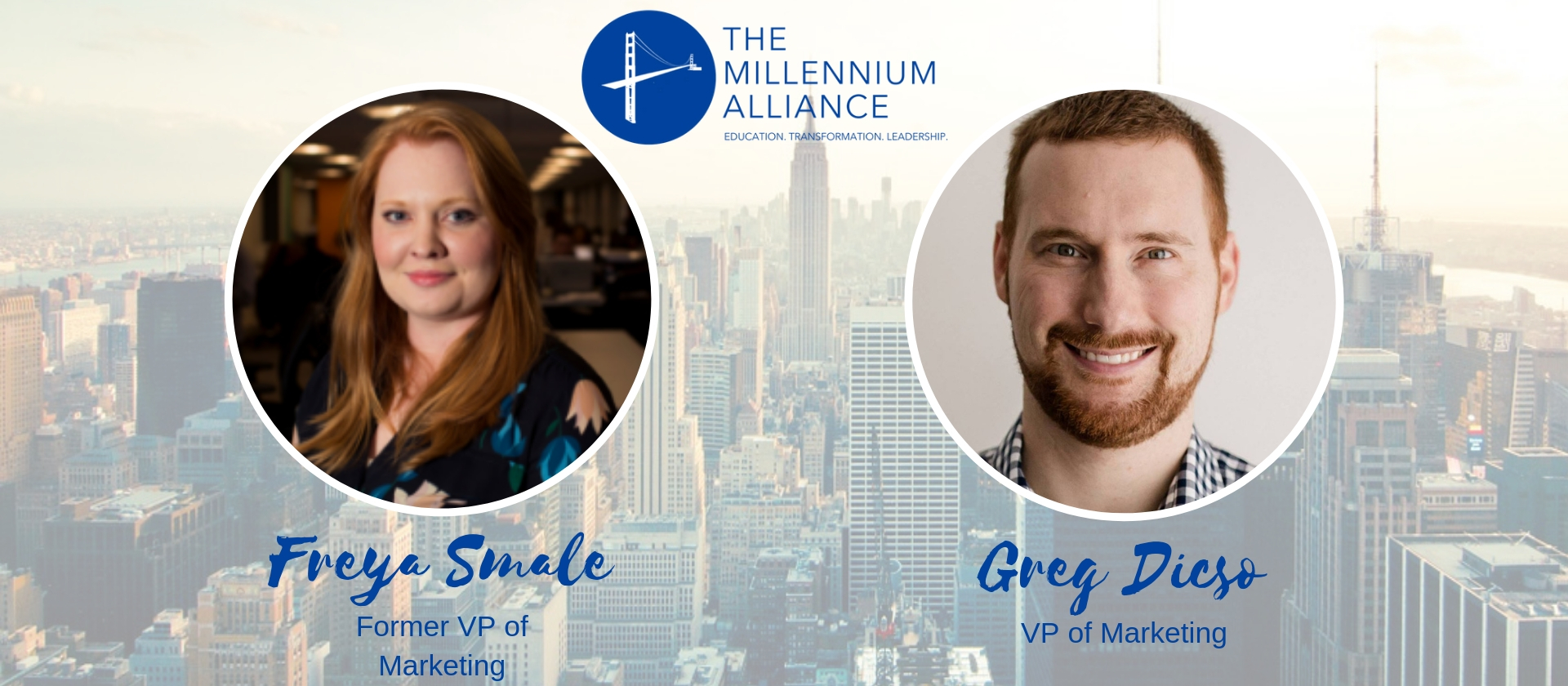
The Millennium Alliance is waving goodbye to our Vice President of Marketing, Freya Smale, and welcoming a new member to our team. Seasoned marketing vet, Greg Dicso will take on her role as our new VP of Marketing.

As we send Freya off to a new chapter in her life back to her hometown in the U.K., we reflect on the hard work that Freya has done in creating and growing our marketing division. We also look to the future and what we are looking forward to when it comes to executing the visions of Digital Diary and beyond, with Greg now in charge.

Digital Diary has sat down with both Freya and Greg to recieve a first-hand look at their thoughts and ideas regarding the change. Take a look below!

Where It All Began…

The role of our VP of Marketing is no easy feat, but Freya took it on with stride. When Freya began her job in 2017, she had a clear vision in mind: to create a team of people passionate about showing the world the message of The Millennium Alliance. Through hard work and persistence, that vision came to life and now, our marketing and product team are an integral part of our company.

Since creating The Millennium Alliance Marketing Department almost two years ago, what do you hope to leave for the company and your team?

My hope for Millennium is that they continue to do what they do to the high standard they are known for. The best part of working for Millennium is the open-environment where innovation is welcomed.

I’m a little biased but the Marketing/Product/Client Services teams are at the center of the business and constantly push for positive change. I could not be more proud of how these teams tackle every challenge that comes their way! In just two years, we’ve launched events, launched and re-launched Digital Diary, founded a marketing team, put in place vital business processes and systems, and so much more!

I hope the teams continue to be the driving force behind the innovation and growth for the company and I can’t wait to see what they come up with next.

Was there something that surprised you when you first started working at The Millennium Alliance?

I was really surprised by how open everyone was to trying and experimenting. The biggest lesson I learned was that failing is okay. Rob and Alex are open to seeing what’s out there and understand that sometimes it doesn’t work! All they ask for is that you try your hardest and learn from everything you do.

What is your favorite memory of being onsite with your fellow staff members and C-Suite Executives?

Being onsite is always hard work but is always fun! Getting to see the finished product that you’ve been working on for months is hugely rewarding.

I can’t lie, but the team drinks post-event are a huge highlight. It’s great to get to celebrate with the rest of the team.

What are you looking forward to the most in the next chapter of your career?

I’m not sure what the next chapter is yet so that’s hugely exciting. I just hope that I’m lucky enough to work somewhere that encourages and challenges the way Millennium does.

“Working with Freya has been an amazing experience. I have learned so much from her, and am so grateful for the opportunity.” – Jenny Schecher, Social Media Manager & Client Services Director 

“Freya is not only an incredible leader, but she is equally the greatest supporter and friend. You can always count on her to get things done to helping you out when you need it, all while bringing joy and laughter into the office (and British chocolates)! I will miss her very much and it is so sad to see her go, but she will do exceptional things no matter where she goes and I am so privileged to have worked with her this year – I am so thankful for you, Freya, you are the best boss ever!” – Catherine Hand, Marketing Coordinator

“Freya is one of the smartest individuals I’ve had the pleasure of working with. She always seemed to be two steps ahead with her forward thinking and has tremendously helped our marketing department. She will be missed by everyone!”- Josh Michi, Senior Alliance Director

“It has been an absolute pleasure working with Freya.  Her dedication, creativity and leadership skills are only a few of the reasons she will be missed. Millennium has benefited greatly from her contributions and we wish her all the best!” – Victoria Rowland, Vice President, Human Resources

Where We Are Now…

Greg Dicso will become our new Vice President of Marketing, and we are excited for what Greg will bring to the table as he joins our team.

Tell us about where you were before The Millennium Alliance and what attracted you to the company?

Prior to joining The Millennium Alliance, I was most recently at Access Intelligence for five years, leading the marketing charge for a number of their largest conferences and trade shows. A big reason I was so attracted to joining the team here at The Millennium Alliance is the tremendous level of growth that this company has experienced in a relatively short period of time, in addition to the limitless potential for the future.

What excites you the most about stepping into such a vital role at The Millennium Alliance?

I’m incredibly excited to bring new ideas to the table to help build on the solid foundation that has already been established in the marketing department. There is huge opportunity to elevate this group to new levels and I’m thrilled to have joined such a dynamic and talented team.

Could you tell us about a few preliminary goals you have in mind for the company and for the marketing department?

For the company as a whole, I would like to further solidify The Millennium Alliance’s position as the premier networking and educational destination for top executive leaders across the globe. As for the marketing department specifically, a big priority early on will be to grow the Digital Diary and help it to reach its full potential as a leading content platform and community.

What was your first impression of Digital Diary and The Millennium Alliance community that’s been created?

I was extremely impressed with the Digital Diary and predict that this will be a vital part of The Millennium Alliance for years to come. Top notch content and key contributors will be the driving force behind building it into an established community, that members turn to daily to remain on the cutting-edge of their industry.

“Greg brings many years of industry experience and we are excited to continue to grow our brand and our footprint with his leadership and fresh ideas based on his global experiences. With so many new and exciting ventures coming in 2019, we know Greg will be leading from the front as we continue grow our C-Suite community.” – Nick Peacock-Smith, Director of Strategic Partnerships

“A new start means fresh ideas and a unique perspective on the future. I’m definitely looking forward Greg leading our team and I’m excited for what he brings to the table.” – Conor Tuohy, Producer, Digital Diary Content 

With a goodbye, comes a hello. We are sad to see Freya leave but look forward to the future. Thank you, Freya, for all your hard work, dedication and passion you have shown our company.

ABOUT THE MILLENNIUM ALLIANCE

Headquartered in Midtown Manhattan, The Millennium Alliance is a leading technology, business, and educational advisory firm. Focusing primarily in areas such as business transformation, executive education, growth, policy, and need analysis. Millennium is quickly becoming one of the most dynamic locations for collaboration across the world.

Millennium Membership offers Fortune 1000 C-Level executives, leading public sector/government officials, and thought leaders across a variety of disciplines unique and exclusive opportunities to meet their peers, understand industry developments and receive introductions to new technology and service advancements to help grow their career and overall company value.

Digital Diary: The No.1 Online Resource for C-Suite Digital Transformers Launches Podcast

NEW YORK, November 1, 2018 – The Millennium Alliance announces the launch of Millennium Live, a Digital Diary podcast, the only podcast dedicated to bringing the latest Digital Business Transformation content to C-Suite Executives from North America’s most progressive industries.

The Podcast is now available exclusively on Soundcloud.

Listen and Subscribe today >>

The first three episodes are already available to listen. Each episode features an exclusive 1-on-1 interview with a business leader.

Check out Soundcloud now to hear from:

  • Sarah Robb O’Hagan, Former CEO, Flywheel Sports, and Founder of ExtremeYou
  • Alan Siegel, President & CEO, Siegelvision Corp
  • John D’Angelo, Executive Director & SVP, Northwell Health

Listen and Subscribe today >>

Freya Smale, Vice President Marketing, Product, and Client Services’ The Millennium Alliance; Editor-In-Chief Digital Diary stated “Here at The Digital Diary we are always looking for new ways to share our content.

Our C-Level audience often mentions one of their biggest challenges is staying ahead of business transformation trends. With so many new innovations and technologies out there, simply finding the time to keep up to date is a challenge! So, we put our heads together and tried to think of how we could help. That’s when we struck upon the idea of a Podcast!

Whether you listen to it on the commute to work or over a sandwich during your lunch break, the #MillenniumLive Podcast shares with you the best digital business transformation strategy out there! 

We hope you enjoy it!”

Listen and Subscribe today >>

About The Digital Diary Team:

Jenny Schecher is a Client Services Director & Social Media Manager at The Millennium Alliance. Jenny is an avid contributor to our blog, Digital Diary, as well as all social media platforms. When she is not writing about digital transformation and technology, she is working with her team to make visions come to life at our events. (and eating all of NYC’s best food.) Follow her on Instagram: @jennyschecs or find her on LinkedIn!

Catherine Hand is the Marketing Coordinator at The Millennium Alliance and Editor of Digital Diary. A recent graduate of Siena College in Albany and New York newbie, Cat assists in the creation and implementation of social media, the event agendas, brochures, E-Books, and frequently write blogs for Digital Diary on topics from all industries from Marketing to Information Technology. You can connect with her on LinkedIn.

Cara Bernstein is Manager, Executive Education Partnerships at The Millennium Alliance. She works with Thought Leaders at The Millennium Alliance assemblies and is also a contributor to Digital Diary. Cara writes about different industries preparing for the digital revolution. You can catch Cara on LinkedIn and on twitter @CaraBernstein

Conor Tuohy is the Video Producer at The Millennium Alliance. He manages the creation of video content and our new podcast on Digital Diary. You can find his creative work on Vimeo!

Subscribe to The Digital Diary today >>

Gartner Released New Technology Predictions For 2019: Does This Scare Executives?

It’s going to take a little bit more than ghosts and goblins to scare executives. However, if you plug in technology moving at a rapid speed, with their business trying to catch up, you may be onto something.

Take the latest report released by Gartner revealing the most anticipated technology trends of 2019. Now that could cause some angst.

Gartner’s 2019 Technology Predictions

We are approaching the end of the year, where experts are futurizing all sorts of predictions within technology that has the ability to change the way major sectors work. Maybe not right away, but eventually.

These predictions portray the idea that technology will continue to be innovative, and influential in major industries. They may even appear to be “scary.”

Are we giving into a hype or reality? You can be the judge. Gartner has released a top 10 list of tech trends for us to consume and digest.

More Than Just Cars

One of the top trends Gartner has predicted has to do with the advancements that cars will make in the future.

“Gartner predicted, by 2021, 10% of new vehicles will have autonomous driving capability, compared with less than 1% in 2017.” Tech Target reports.

This includes human-assisted capabilities as well as different levels of automation.

AI Will Continue To Advance

If you think that AI is so last year, think again. Gartner predicts that AI will continue to be a driving force in the coming years.

“Gartner predicted, by 2020, at least 40% of new application development projects will have AI code developers on the team.” Tech Target reports.

Digital Space Will Connect Us

Digital environments will continue to expand in the next year. These spaces will start to evolve, including other factors of technology, like blockchain, and IoT. Although we have seen smart cities evolve this year, They will continue to mature.

To view the full list of predictions, click here.

So The Question Remains…

Are executives scared of these predictions? The only way to find out is if industries take these predictions head on and prepare for the future. These predictions eventually will no longer just be an idea, or a vision, but instead a concrete change in businesses.